
Your Cart is Empty
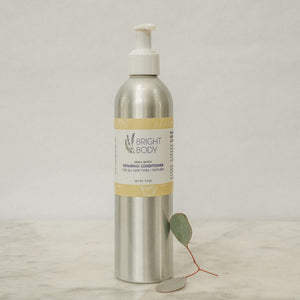


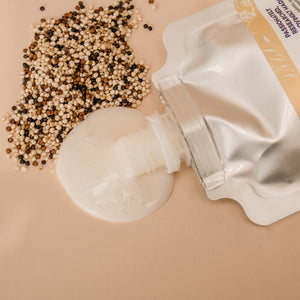
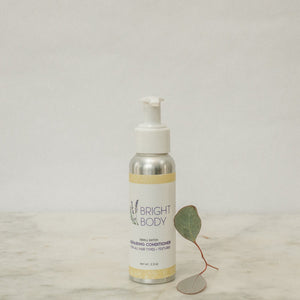

Waves, curls, or coils need a little nourishment? Our Repairing Conditioner is made just for that purpose. We’ve concentrated a blend of herbs, plants, and other evidence-backed ingredients to repair and deeply hydrate medium to high porosity waves, curls, and coils. The result is soft, supple hair without heaviness or greasy residue.
Not sure about your porosity? Read more here.
Jojoba oil moisturizes, while marshmallow root increases hydration and detangles with a silky slip. Quinoa protein and vitamin B5 both reinforce hair damaged by heat or color.
It’s a flexible formula that works as a leave-in for thick + thirsty hair or a rinse-out for hair prone to buildup. Use Repairing Conditioner however works best for your hair type, the season, and shifting humidity levels.
Repairing Conditioner is lightly scented with refreshing peppermint, eucalyptus, and rosemary. It is color-safe and free of sulfates, silicones, and phthalates.
Have thin hair prone to build-up? Try our Post-Wash Herbal Lemon Rinse instead.
How to Use: After washing with Bright Body Shampoo, apply from mid-lengths to ends of hair. Leave in for dry, frizzy, and/or coarse hair, or rinse out for finer hair.
References
Dakhili, S., Abdolalizadeh, L., Hosseini, S. M., Shojaee-Aliabadi, S., & Mirmoghtadaie, L. (2019). Quinoa protein: Composition, structure and functional properties. Food Chemistry, 299, 125161. https://doi.org/10.1016/j.foodchem.2019.125161
Gad, H. A., Roberts, A., Hamzi, S. H., Touiss, I., Altyar, A. E., Kensara, O. A., & Ashour, M. L. (2021). Jojoba Oil: An Updated Comprehensive Review on Chemistry, Pharmaceutical Uses, and Toxicity. Polymers, 13(11), 1711. https://doi.org/10.3390/polym13111711
Karimi, S., Ghanbarzadeh, B., Roufegarinejad, L., & Falcone, P. M. (2021). Polysaccharide extracted from Althaea officinalis L. root: New studies of structural, rheological and antioxidant properties. Carbohydrate Research, 510, 108438. https://doi.org/10.1016/j.carres.2021.108438
Scott, L. N., Fiume, M., Bergfeld, W. F., Belsito, D. V., Hill, R. A., Klaassen, C. D., Liebler, D. C., Marks, J. G., Jr, Shank, R. C., Slaga, T. J., Snyder, P. W., & Heldreth, B. (2022). Safety Assessment of Panthenol, Pantothenic Acid, and Derivatives as Used in Cosmetics. International Journal of Toxicology, 41(3 Suppl), 77–128. https://doi.org/10.1177/10915818221124809